Believe it or not, I didn't know I was so horrified by the very idea of dailies (Publications come out at 6p.m. on the stories reported on that day....Its maddening!) unless I woke up at 2 a.m. last night and kept staring at my cellphone. I thought I would manage to remain quite chilled out until that incident happened. I didn't understand why that happened. But, yes. It did. This was what I was going to do in the future and I realized it late. Like, in the night when I freaked out.
I woke up at 5 a.m. to bathe and get ready (*considering the number of people in my room and I had to go to the event*). So, couldn't take risk of waking up later than 5.30 a.m. Because i was writing my magazine article last night, I couldn't do a research on the event I was assigned to attend to. (Though there wasn't any information available on the internet, I did a Google search on it). I came to the lab and checked the way to Kidwai Institute of Oncology because that was where the event was happening. I had no clue what the event was all about, who all will be present at the event.(except for Police commissioner being the chief guest).
Took an auto to the wrong place. Got to know the address through a motorcyclist when we stopped in the traffic. (foolish...I know). I took an auto rickshaw to Kidwai institute. Finally, we made it.
It wasn't easy. None of them at the institute knew about the seminar. Had a hard time finding if there was any seminar being held at all. finally, spoke to the Social welfare Officer and she told us about Children's day being celebrated at the children's ward at the institute. they were all cancer affected kids between the ages 0 to 14. During the event, I found "actual journalists" (because we are trainee journalists) doing no work at all. (not kidding) I was surprised. I thought they knew everything about it. But, all they did was to take the press release from the organizers of the event and have snacks. (No offense) But, that was what was happening, except for one TV journalist struggling to get everyone's byte or SOT (Sound on tape).
I'm not praising myself,but, I found myself probing many people - cancer patients (kids), their parents, Director and medical director of Cryo-Save (European stem cells bank), Social Welfare Officer, Head of Department of Children's ward, Police commissioner (Shankar Bidri) and other sources present at the event.
We were always told to report and get extra information than the obvious (in this case, more info on the event, except for the press release that was prepared a day before). I did my best to talk to every single person I found and thought was important for my report.
And, I realised that I did better than others (not boasting, but true). I was feeling good about covering an event that was chaotic, where finding sources of information was quite difficult because BIG people leave the place as soon as the event is done. But, I somehow managed.
After the event, I went to cafe coffee day, nearby and thanks to the ambience ( *Never felt so thankful*) because I was able to type out the event's report. 20 minutes 520 words (which was later edited by my sub-editor to 460 words)! BINGO! Never knew my pace was good until today. I was happy. not because of the pace at which I wrote my report but, got another story out of the event and wrote about 400 words there. So, 1 hour and almost both the stories done. Wow!!!
But, couldn't find a cyber cafe anywhere in the proximity to mail my story to my coordinator. Till 2 p.m. I was looking out for one. But, found none. thanks to my friend's net on Phone. And then, I sent my stories. Done.
Was relieved. And, at the end of the day, I did my best to survive this phase, though there was madness in the newsroom. I did it.
I realized that I like the dailies :) It is fun (only if your stories work). I was fortunate enough that way. And, yes, I SURVIVED IT. (*feels so better and this keeps me going for the next beat) :):)
Monday, November 15, 2010


Friday, November 12, 2010
Partial Parity
Note: Whatever I have written is very personal and is my opinion. Feel free to express yours.
__________________________________
__________________________________
“We are professionals” says my Professor. How professional are we? is a big question here. Keeping our hard news reporting aside however planned and unchangeable our schedules are, there is some sort of hierarchy that exists in this institution. I never felt the urge to write about it, until today. Bias exists everywhere. No matter however “PROFESSIONAL” the institution is or claims to be.
Favoritism /bias/partiality (whatever one calls it) towards a particular set of “pseudo intellectuals” always exists. And, these pseudo intellectuals always feel the necessity to be in “good terms” with the ones who are biased or partial towards them. Be it school, college/university or any institution, it is undeniable.
If we look at the very definition of it, it means favoring a person or group over another. It all begins by developing relationships, personal or professional. It could be a student-teacher relationship, mother/father-daughter/son relationship, and employee-manager/boss relationship, whatever the case is. For example: If we actually analyse this, this concept is something related to our psychology. It is like…things we like the most, people we like the most, anything you like, - this whole concept of liking itself brings in bias or favoritism at some point of time.
And, that point of time is (as the definition says…) when there is more than one person or a group and you like/support/favour that group or person over the other, it creeps in. But, what one has to look at is, IS bias/partiality spoiling people from doing their work or doing good to them? (This is debatable too) because at the end of the day it is the individual who has to struggle to flourish, though partiality helps them to a certain extent.
For example: In Spain Philip III was enthroned in 1598 and duke of Lerma rose to power because of this concept of favoritism.
And, whenever my Professor says we are “PROFESSIONALS” and we are expected to be neutral and not biased about anything. (Precisely, that is what my profession demands) I rethink. Only because when it comes to statements, people make them all the time. But, when it has to be applied to them, they do not FOLOW. So, the question here is, why make a statement, when you yourself do not follow it?
Sunday, October 31, 2010
The "humane side" of rural India
I've been waiting to update my blog for a week now. Yaaayyy!!! Now I feel so relaxed after having started to type everything (and thanks to the free time...NOW!)
_________________________________________________
About Bagepalli Taluk


Bagepalli is one of the most backward taluks in Karnataka, Kolar District. Literacy rate according to a 2003 report is about 52 percent in the taluk. But, in reality it is about 40 percent. Language spoken in the Taluk is Telugu.Geographical location: Andhra Pradesh and Karnataka Border.
Our Journey to Bagepalli:

I was made the team coordinator (because people who knew any South Indian language were made coordinators) and had to be responsible for the group in all ways. At first, I was skeptical about my team members but as the days passed by in the village ours was the BEST group with the best team members (*personal opinion*). On 24th Oct, 2010, I woke up at 4.30 a.m. because our bus was at 6 a.m.. After being dropped at Majestic (KG bus stand), we headed to Vijaya Cafe for an awesome breakfast and then got it done by 8 and luckily got a bus to Bagepalli. (*looked like buses were waiting for us* -sigh of relief)
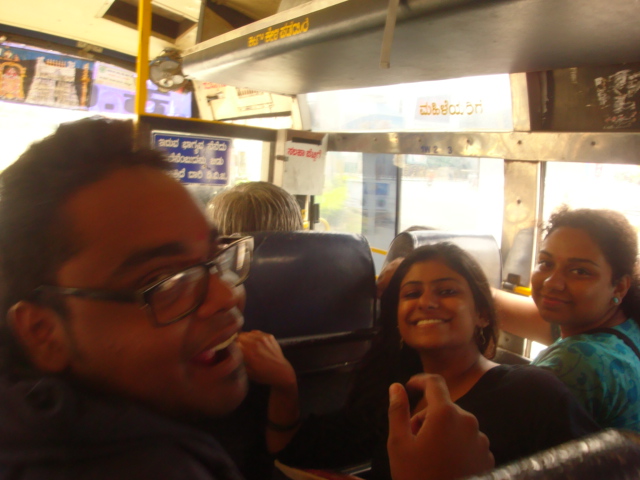
We were on our way to Bagepalli town and assuming the conductor to know telugu, I spoke to him in Telugu and luckily he replied in the same language. *smiles*
 In the bus
Everyone was happy going to their respective Taluks. It was the "one week break" we desperately needed from hectic schedules at IIJNM. But, we were equally worried about our accommodation and the rest of the things. But, thank god! I arranged all this before we actually got there. We had to take a bus to Rachavarepalli from Bagepalli and finally got there. After this, everything seemed very confusing. We had to take an autorickshaw to Chinaganapalli (the village we stayed in) and we did. The person who had to accommodate us was waiting for us right there. We felt much relaxed (Because most other teams did not know where they were gonna stay and Ours was decided and properly planned).
 Our home... sweet HOME :)
He asked us to stay at his place. Gave us an room to stay, TV and amazing home cooked food (his mom made). We were asked to adjust and whatever we wanted was only a place to sleep. We had no idea that we would have all this in our so called "temporary home".
That evening people in the village kept wondering who we were and kept asking others where we were from and why were we there in their village. But, whatever it is, people in villages are much welcoming and warm compared to people living in the cities. (Got to know this). We stayed with all kinds of cattle - cows, sheep, buffaloes - and enjoyed every bit of it. (Though my friends made fun of the "Buffalo's sussu ka factory" :P:D).
 Weirdest Autorickshaw I have ever seen
First Day - Patalpalya, Tholapally and Somanathapura
 My teammates
We visited these places in Auto. Our driver, Suresh Anna, made it easier for us by knowing every place there. As planned, our schedule for the first day was to visit the above mentioned villages, of which, Patapalya was one of the five hobillies of the Taluk. We visited the angandwadi center there, met the two kids and saw how anganwadi workers meeting is conducted. Then, visited the PHC at Patapalya.
Lack of doctors, people believing in superstitions to cure diseases, child marriages, using same bedsheets for deliveries of mothers, lack of medicines for diseases, lack of awareness among villagers and many more. All these were still prevalent in villages. Sadl;y, I walked out of the PHC assuming the Panchayat members of Patapalya to tell something informative and useful about the hobblie. But, none of the members knew when the elected President and the secretary of the Panchayat would "visit" the office. (It is their duty to be in the office from 10.30 a.m. to 5 p.m.). But, except them, you will find members of the panchayat in the office who give most important information about the socio-economic conditions in the surrounding villages.
Next stop was at Tholapally, where anganwadi center was empty, angandwadi assisntant was sleeping, Panchayat office closed and nothing worked there.
 Gummanayana Alaya ruled by Navakota Empire
We then went to visit a 100 year old fort called "Gummanayana Alaya" at Tholapally. It was almost 3000 ft high and we had to go to the hill top. But, the most funniest part was - one of my friends falling repeatedly like "kungfu panda" - that was the most hilarious part of the day and Yes! he made my day. And, thanks to my CONVERSE flip flops which had grip and helped me climb rocks, while my friend was constantly falling down. :P:P
Somanathapura was again a tragedy. Nothing went right there. The only person we met was the Milk dairy secy.
On the whole, first day didn't go that well. Apart from visiting the fort, we realised that we had to see such grave and harsh realities again and again in the coming days. We were back home. Tired. Two of them slept. I was sitting outside the house. Aunty, served tea and some snacks. sitting there, I wondered how we in the cities cannot stand any outsider in our area/ locality, but these villagers respect you so much for being a part of this village and making an effort to know them. And, what made me happy was I knew I would become a part of them very soon.
 Clicked this from a moving autorickshaw on a bumpy road
Day 2 - The most tiring day
We get up from sleep and we had aunty serving fresh,hot milk (actual milk and not the watery one we get at our hostel), pours hot water in the bucket for us (like moms do) and then serves breakfast for all of us together.
We had to visit three villages. But, ended up visiting about 9 villages. We began our journey on the bumpy roads of the taluk, almost sitting on each other each time there were potholes. Sometimes, the auto's tyres were in the air and sometimes us. On thr rocky road, we felt we would never come back alive.Whole day Suresh anna was with us. We went to Billur, Rachhhevuru, Pulagallu, Tholapally again, Chakavelu and four other villages. (forgot names :P:P ) It went well. Met a freedom fighter from Rachheruvu, entered Andhra Pradesh as Raccheruvu was part of AP but was geographically under Karnataka. (And, people in the border areas never know which state they belong to because both states interfere in their matters and end up doing literally nothing for them. NOTHING!) This is one of the reasons why they remain the most backward regions in the state.

A 1st standard student of PSS Educational Trust, a private school in Chakalvelu
Then we got a shock at one the PHC's at Shivapura. We got to know that a Unani (Ayush) doctor was giving aloepathic medicines to the patients . (He can be sued for it) But, he himself told that he had no other choice because patients always wanted injections thinking they would cure their disease.this shows the pathetic conditions of PHC's and lack of paramedics and doctors in our country.
It was a hectic day. Tiring. even after we got came home, we had the feeling of travelling in the auto, on those bumpy roads where we almost died. But, I survived it. That's how my Day 2 ended.
Day 3 - Almost did the same things
 Rakshita and me :)
One most important thing I have to mention what I did on Day 3 was ate properly. (I felt the need to mention this because we were invited for lunch at our Auto Suresh anna's sissy's place). And, trust me, she cooked AWESOME food:):). Adding to this, (given my love for kids) Rakshita, a six months-old baby made my day.
Day 4 - The day I didn't wanna work!
There's a point of time when one gets annoyed seeing others in their group not work and relying completely on that person. Yes! This was that day. I was seriously pissed off with my team members (not their fault - language barrier) because I had to do every single thing. But, yes! I did it. And, it didn't end on a good note.
Because, I did not get any data from the places I visited.
Totally annoyed, took a bus with my team members and came back HOME. Not to vent my anger on others anymore, the best thing I could do was to sleep. And, I slept. Woke up and had tea, sitting on the cement slab outside the house.

Thinking about some random stuff, I sipped my tea and saw two kids on the other side of the street. In the meantime, the dog (one with dark circles, probably very old man he is) got entangled by a rope that was tied to a cow. Both, the cow and the dog were struggling to help each other. Nothing worked. I asked those two kids to get the dog out of that place because I dint know how a cow would react if I went and did something to free the dog. Assuming the kids to know something, I asked them to help. And, they did.
That's when my day started getting better. I realized this at the end of the day. After that, the kids came n spoke to me and introduced themselves. Venu and Sreekanth. Innocent, simple and full of respect is what comes to my mind when I think of them.
We spoke for sometime and then they asked me if I could teach them English lesson on Kalpana Chawla because their English teacher died in a accident. So, I had to become their temporary English teacher.And, yes...I agreed to teach.
I was explaining it in Telugu as they did not understand English properly. So translation was a big challenge to me. (Until then, I never realised that my mother tongue would come to my rescue and was very thankful about it). And yes, I used to speak in their dialect (telugu has different dialects which comes from three different regions in Andhra Pradesh - Andhra, Telangana and Rayalaseema). And, they spoke in the Rayalaseema dialect which I knew very well because my dad belonged there.

And that day I was actually very happy and satisfied, not because I taught kids who asked me, but I dreamt of teaching people in the village all the time.(Like I always wanted to serve people in some way or the other, so education was the best bet). and the kids told me " No one has taught them so patiently until then". I was very happy because more than teaching them, I realised I became someone very important to them in their life and that is the way they would remember me. and yes, they made my day. :):) Also, it is one of the most memorable days of my life until now.
Day 5 and 6 (The day I didnt wanna leave):
Day 5 was okay. Not that great. Two of my firends had already left and my other two friends and I stayed back. But, day 6 was something I never wanted. On the first day, I was waiting for this day. And, when it was that day, I never wanted it only because it was the day we were leaving. Sad because - One, I loved the village and the people and everything in those 6 days. Two - I knew I had to get back to hectic schedule in college which would make me almost forget that we spent 6 most amazing days in the villages of Bagepalli. Auto anna came to pick us up and we had to leave the place. We left to Bagepalli and were feeling nostalgic.
What I felt and learnt:
From day 1 people in the village never treated us as outsiders though we actually were. They gave us space to live in the little space they lived in. They cooked food for us, liked us, expected us to teach their kids and most importantly treated us as one among them. (which is very much in contrast with what people in the cities do - not all - no offense - But, we cannot stand two people who come and stand at our door and act like we don't care. May be do not even talk to them) But, the villagers taught us many more things. To live in a world full of problems but still wear a smile on your face. They do NOT have materialistic desires, like we do. They feed you even if they STARVE. And, that is the REALITY of people living in rural INDIA. And, more HUMANE.
 AWESOME food
I loved the autorickshaw rides everyday. sitting at the back of the auto with my friend, clicking pictures of random things, staring at the tree that stands alone from the rest of them, looking at the road that never seems to end, which also could be the GLORY ROAD and still remain happy in the simplest way ever.
Loved the time spent in the rural set-up with my teammates (not all except three of 'em) and yes, every one has to experience their way of living. Trust me on this. (*unless you know how to adjust*)
Waiting to go back there....
P.S. Thank you Shreya Kumar, Prarthito and Rashi :):):)

_________________________________________________
About Bagepalli Taluk


"A view from Nowhere" - (attributed to Jay Rosen)

People still shift their home by using Horses as the means of transport
Bagepalli is one of the most backward taluks in Karnataka, Kolar District. Literacy rate according to a 2003 report is about 52 percent in the taluk. But, in reality it is about 40 percent. Language spoken in the Taluk is Telugu.Geographical location: Andhra Pradesh and Karnataka Border.
Our Journey to Bagepalli:


Bagepalli Town
I was made the team coordinator (because people who knew any South Indian language were made coordinators) and had to be responsible for the group in all ways. At first, I was skeptical about my team members but as the days passed by in the village ours was the BEST group with the best team members (*personal opinion*). On 24th Oct, 2010, I woke up at 4.30 a.m. because our bus was at 6 a.m.. After being dropped at Majestic (KG bus stand), we headed to Vijaya Cafe for an awesome breakfast and then got it done by 8 and luckily got a bus to Bagepalli. (*looked like buses were waiting for us* -sigh of relief)
We were on our way to Bagepalli town and assuming the conductor to know telugu, I spoke to him in Telugu and luckily he replied in the same language. *smiles*

Everyone was happy going to their respective Taluks. It was the "one week break" we desperately needed from hectic schedules at IIJNM. But, we were equally worried about our accommodation and the rest of the things. But, thank god! I arranged all this before we actually got there. We had to take a bus to Rachavarepalli from Bagepalli and finally got there. After this, everything seemed very confusing. We had to take an autorickshaw to Chinaganapalli (the village we stayed in) and we did. The person who had to accommodate us was waiting for us right there. We felt much relaxed (Because most other teams did not know where they were gonna stay and Ours was decided and properly planned).

He asked us to stay at his place. Gave us an room to stay, TV and amazing home cooked food (his mom made). We were asked to adjust and whatever we wanted was only a place to sleep. We had no idea that we would have all this in our so called "temporary home".
That evening people in the village kept wondering who we were and kept asking others where we were from and why were we there in their village. But, whatever it is, people in villages are much welcoming and warm compared to people living in the cities. (Got to know this). We stayed with all kinds of cattle - cows, sheep, buffaloes - and enjoyed every bit of it. (Though my friends made fun of the "Buffalo's sussu ka factory" :P:D).

First Day - Patalpalya, Tholapally and Somanathapura

We visited these places in Auto. Our driver, Suresh Anna, made it easier for us by knowing every place there. As planned, our schedule for the first day was to visit the above mentioned villages, of which, Patapalya was one of the five hobillies of the Taluk. We visited the angandwadi center there, met the two kids and saw how anganwadi workers meeting is conducted. Then, visited the PHC at Patapalya.
Lack of doctors, people believing in superstitions to cure diseases, child marriages, using same bedsheets for deliveries of mothers, lack of medicines for diseases, lack of awareness among villagers and many more. All these were still prevalent in villages. Sadl;y, I walked out of the PHC assuming the Panchayat members of Patapalya to tell something informative and useful about the hobblie. But, none of the members knew when the elected President and the secretary of the Panchayat would "visit" the office. (It is their duty to be in the office from 10.30 a.m. to 5 p.m.). But, except them, you will find members of the panchayat in the office who give most important information about the socio-economic conditions in the surrounding villages.
Next stop was at Tholapally, where anganwadi center was empty, angandwadi assisntant was sleeping, Panchayat office closed and nothing worked there.

We then went to visit a 100 year old fort called "Gummanayana Alaya" at Tholapally. It was almost 3000 ft high and we had to go to the hill top. But, the most funniest part was - one of my friends falling repeatedly like "kungfu panda" - that was the most hilarious part of the day and Yes! he made my day. And, thanks to my CONVERSE flip flops which had grip and helped me climb rocks, while my friend was constantly falling down. :P:P
Somanathapura was again a tragedy. Nothing went right there. The only person we met was the Milk dairy secy.
On the whole, first day didn't go that well. Apart from visiting the fort, we realised that we had to see such grave and harsh realities again and again in the coming days. We were back home. Tired. Two of them slept. I was sitting outside the house. Aunty, served tea and some snacks. sitting there, I wondered how we in the cities cannot stand any outsider in our area/ locality, but these villagers respect you so much for being a part of this village and making an effort to know them. And, what made me happy was I knew I would become a part of them very soon.

Day 2 - The most tiring day
We get up from sleep and we had aunty serving fresh,hot milk (actual milk and not the watery one we get at our hostel), pours hot water in the bucket for us (like moms do) and then serves breakfast for all of us together.
We had to visit three villages. But, ended up visiting about 9 villages. We began our journey on the bumpy roads of the taluk, almost sitting on each other each time there were potholes. Sometimes, the auto's tyres were in the air and sometimes us. On thr rocky road, we felt we would never come back alive.Whole day Suresh anna was with us. We went to Billur, Rachhhevuru, Pulagallu, Tholapally again, Chakavelu and four other villages. (forgot names :P:P ) It went well. Met a freedom fighter from Rachheruvu, entered Andhra Pradesh as Raccheruvu was part of AP but was geographically under Karnataka. (And, people in the border areas never know which state they belong to because both states interfere in their matters and end up doing literally nothing for them. NOTHING!) This is one of the reasons why they remain the most backward regions in the state.

A 1st standard student of PSS Educational Trust, a private school in Chakalvelu
Then we got a shock at one the PHC's at Shivapura. We got to know that a Unani (Ayush) doctor was giving aloepathic medicines to the patients . (He can be sued for it) But, he himself told that he had no other choice because patients always wanted injections thinking they would cure their disease.this shows the pathetic conditions of PHC's and lack of paramedics and doctors in our country.
It was a hectic day. Tiring. even after we got came home, we had the feeling of travelling in the auto, on those bumpy roads where we almost died. But, I survived it. That's how my Day 2 ended.
Day 3 - Almost did the same things

One most important thing I have to mention what I did on Day 3 was ate properly. (I felt the need to mention this because we were invited for lunch at our Auto Suresh anna's sissy's place). And, trust me, she cooked AWESOME food:):). Adding to this, (given my love for kids) Rakshita, a six months-old baby made my day.
Day 4 - The day I didn't wanna work!
There's a point of time when one gets annoyed seeing others in their group not work and relying completely on that person. Yes! This was that day. I was seriously pissed off with my team members (not their fault - language barrier) because I had to do every single thing. But, yes! I did it. And, it didn't end on a good note.
Because, I did not get any data from the places I visited.
Totally annoyed, took a bus with my team members and came back HOME. Not to vent my anger on others anymore, the best thing I could do was to sleep. And, I slept. Woke up and had tea, sitting on the cement slab outside the house.

Venu and Sreekanth
Thinking about some random stuff, I sipped my tea and saw two kids on the other side of the street. In the meantime, the dog (one with dark circles, probably very old man he is) got entangled by a rope that was tied to a cow. Both, the cow and the dog were struggling to help each other. Nothing worked. I asked those two kids to get the dog out of that place because I dint know how a cow would react if I went and did something to free the dog. Assuming the kids to know something, I asked them to help. And, they did.
That's when my day started getting better. I realized this at the end of the day. After that, the kids came n spoke to me and introduced themselves. Venu and Sreekanth. Innocent, simple and full of respect is what comes to my mind when I think of them.
We spoke for sometime and then they asked me if I could teach them English lesson on Kalpana Chawla because their English teacher died in a accident. So, I had to become their temporary English teacher.And, yes...I agreed to teach.
I was explaining it in Telugu as they did not understand English properly. So translation was a big challenge to me. (Until then, I never realised that my mother tongue would come to my rescue and was very thankful about it). And yes, I used to speak in their dialect (telugu has different dialects which comes from three different regions in Andhra Pradesh - Andhra, Telangana and Rayalaseema). And, they spoke in the Rayalaseema dialect which I knew very well because my dad belonged there.

And that day I was actually very happy and satisfied, not because I taught kids who asked me, but I dreamt of teaching people in the village all the time.(Like I always wanted to serve people in some way or the other, so education was the best bet). and the kids told me " No one has taught them so patiently until then". I was very happy because more than teaching them, I realised I became someone very important to them in their life and that is the way they would remember me. and yes, they made my day. :):) Also, it is one of the most memorable days of my life until now.
Day 5 and 6 (The day I didnt wanna leave):
Day 5 was okay. Not that great. Two of my firends had already left and my other two friends and I stayed back. But, day 6 was something I never wanted. On the first day, I was waiting for this day. And, when it was that day, I never wanted it only because it was the day we were leaving. Sad because - One, I loved the village and the people and everything in those 6 days. Two - I knew I had to get back to hectic schedule in college which would make me almost forget that we spent 6 most amazing days in the villages of Bagepalli. Auto anna came to pick us up and we had to leave the place. We left to Bagepalli and were feeling nostalgic.
What I felt and learnt:
From day 1 people in the village never treated us as outsiders though we actually were. They gave us space to live in the little space they lived in. They cooked food for us, liked us, expected us to teach their kids and most importantly treated us as one among them. (which is very much in contrast with what people in the cities do - not all - no offense - But, we cannot stand two people who come and stand at our door and act like we don't care. May be do not even talk to them) But, the villagers taught us many more things. To live in a world full of problems but still wear a smile on your face. They do NOT have materialistic desires, like we do. They feed you even if they STARVE. And, that is the REALITY of people living in rural INDIA. And, more HUMANE.

I loved the autorickshaw rides everyday. sitting at the back of the auto with my friend, clicking pictures of random things, staring at the tree that stands alone from the rest of them, looking at the road that never seems to end, which also could be the GLORY ROAD and still remain happy in the simplest way ever.
Loved the time spent in the rural set-up with my teammates (not all except three of 'em) and yes, every one has to experience their way of living. Trust me on this. (*unless you know how to adjust*)
Waiting to go back there....
P.S. Thank you Shreya Kumar, Prarthito and Rashi :):):)

Thursday, September 30, 2010
The day I exercised my RIGHT as a CITIZEN :)
25th September, 2010, for me - is a memorable day. Though most of it was screwed big time (couldn't finish story idea).
Okay...the reason I'm "hyping" (like the media hype for TRP's, but that's not the case here) it up so much is because I filed an RTI. (Ohh...wait! not one RTI, but 4). Not just filed an RTI, but had to go through a lot before submitting the application at Karnataka Information Commission (KIC) Office (M.S. Building).
_________________________________________________
My day began with the auto driver coming 45 minutes late (Can't help it, "Indian" timings). He claimed he was having breakfast (For an hour? DUH!). Okay after a lot of cribbing, my friend and I took a bus to MAJESTIC (K.G Bus stand). The bus we got into, was moving at a pace of 1 metre per minute (TRAFFIC!) which was a result of previous day's rain (which apparently, flooded the city - but sadly, not at Kumbalgudu). It was humid, people in the bus looked frustrated, some restless people just got down the bus and walked past many vehicles to catch another bus some 200 metres away. Roads with pot holes (Possible story idea - killed!), traffic congestion, pollution, high emissions (All possible story ideas - Acc to our Vice Dean - "Possibly, but look for something new") and stink of overflowing drains, stench of garbage (*looks away* - enough of such stories!).
Finally after a lot of struggle, we reached MAJESTIC bus stand after 1 hour 45 minutes.Our first plan for the day was, to go to KIC and file "an" RTI (Right to Information Act). We got to KIC office and asked them if we could submit the RTI forms (I took a print out of the form). One guy, didn't know English nor Hindi , then we were sent to another employee, who told us to fill the form, they had. I filled one, then ran to the office, then asked for four more forms. (*feels happy*) As it was my first chance, I thought I could utilize this opportunity fully and file 3 more. And, I did. Information I wanted was on IMR(Infant Mortality Rate) and MMR (Maternal Mortality Rate) in Bangalore, for the past five years. And I have decided not to reveal the rest, because they are my story ideas (Can't make them public now ...lolz).
I went into the office, smiling. (Assuming, I can finally submit the forms ). But, it wasn't over. I was asked to give an I.P.O (Postal Order) of Rs.10. (But, the form said "Pay Rs.10 in the form of cash or through I.P.O). I did not know it was complusory to give an I.P.O (Lesson 1). My friend and I asked people where Post office was and rushed to the one in the premises of M.S. Building. Huh! We asked for I.P.O and they said they closed the account. (Ohh...Why did they close an account? Because, it was 1.40 p.m and the office is open till 1 p.m. only on SATURDAYS - Lesson 2) We begged them to open an account or enter it into Monday's account. (But, that fellow seemed unyielding) To add to our misery or may be the other way round, he told us that the Head office (G.P.O) is open till 3 p.m. We rushed to head office. Actually walked. May be the fastest I've ever walked (Looked like I could win a race).
Ohh...Before this we took an auto and we told the driver to take us to GPO. that fellow dropped us in between because it was one way (Some Crap!) We got down, didn't pay him money. (how can I forget? ...My friend was bankrupt and I had a fresh Rs.500 note without change- Beat that!) We looked at guavas on the way, but, decided to get back to them after a while. Finally, bought 15 I.P.O's and got to know how they look (Lesson 3) and got back to office, thinking this is DONE! But, I didn't know there was something in store for us.
I was asked to get photocopies of the forms and the I.P.O. Figured out the nearest "XeroX' shop, got them photocopied and rushed back expecting the officer to ask us to do something else too. Gave him the photocopies, he put a KIC stamp on it. Gave them back to us, and kept the originals with him. "Done, Thank you" was what he said. We then understood that FINALLY we filed RTI's, inquired about the time period for the response (which is 30 days) and found out the possibilities of not receiving information within 30 days.
We got out of the office. Obviously smiling. The reason behind our smiles was that we learnt how to file an RTI which took almost 3 hours. And, then we parted ways and I went to KSCB (Karnataka Slum Clearance Board), but did not get information and was asked to go to Viajayanagar BDA. Travelled all the way to vijayananagr. Walked for 1.5 kms to find the office, finally found it. And then, from there I was aked to go to Domlur Revenue Office. by the time I got to Domlur, it was 6 p.m and Yes, luck never favours. Office closed.
Wow! Great day. Celebrate! Bullshit. Disappointed, I took a bus to Rajarajeshwari Nagar, went to Gopalan Aracade, McDonalds as usual became my saviour. (Happens always!) And, reached hostel at 9 p.m.
It was one HELL of a day! Gosh!!
But, YES, I was proud to exercise my RIGHT as a CITIZEN by filing an RTI :)
P.S. Demanding information is your RIGHT. Utilize the RTI, know it, use it and become a responsible citizen. Don't be a passive citizen. And, to know more about the act, Click Here. Here's the links to state information commissions - Link: http://www.cic.gov.in/state_chief__information_commissioners.htm.
Okay...the reason I'm "hyping" (like the media hype for TRP's, but that's not the case here) it up so much is because I filed an RTI. (Ohh...wait! not one RTI, but 4). Not just filed an RTI, but had to go through a lot before submitting the application at Karnataka Information Commission (KIC) Office (M.S. Building).
_________________________________________________
My day began with the auto driver coming 45 minutes late (Can't help it, "Indian" timings). He claimed he was having breakfast (For an hour? DUH!). Okay after a lot of cribbing, my friend and I took a bus to MAJESTIC (K.G Bus stand). The bus we got into, was moving at a pace of 1 metre per minute (TRAFFIC!) which was a result of previous day's rain (which apparently, flooded the city - but sadly, not at Kumbalgudu). It was humid, people in the bus looked frustrated, some restless people just got down the bus and walked past many vehicles to catch another bus some 200 metres away. Roads with pot holes (Possible story idea - killed!), traffic congestion, pollution, high emissions (All possible story ideas - Acc to our Vice Dean - "Possibly, but look for something new") and stink of overflowing drains, stench of garbage (*looks away* - enough of such stories!).
Finally after a lot of struggle, we reached MAJESTIC bus stand after 1 hour 45 minutes.Our first plan for the day was, to go to KIC and file "an" RTI (Right to Information Act). We got to KIC office and asked them if we could submit the RTI forms (I took a print out of the form). One guy, didn't know English nor Hindi , then we were sent to another employee, who told us to fill the form, they had. I filled one, then ran to the office, then asked for four more forms. (*feels happy*) As it was my first chance, I thought I could utilize this opportunity fully and file 3 more. And, I did. Information I wanted was on IMR(Infant Mortality Rate) and MMR (Maternal Mortality Rate) in Bangalore, for the past five years. And I have decided not to reveal the rest, because they are my story ideas (Can't make them public now ...lolz).
I went into the office, smiling. (Assuming, I can finally submit the forms ). But, it wasn't over. I was asked to give an I.P.O (Postal Order) of Rs.10. (But, the form said "Pay Rs.10 in the form of cash or through I.P.O). I did not know it was complusory to give an I.P.O (Lesson 1). My friend and I asked people where Post office was and rushed to the one in the premises of M.S. Building. Huh! We asked for I.P.O and they said they closed the account. (Ohh...Why did they close an account? Because, it was 1.40 p.m and the office is open till 1 p.m. only on SATURDAYS - Lesson 2) We begged them to open an account or enter it into Monday's account. (But, that fellow seemed unyielding) To add to our misery or may be the other way round, he told us that the Head office (G.P.O) is open till 3 p.m. We rushed to head office. Actually walked. May be the fastest I've ever walked (Looked like I could win a race).
Ohh...Before this we took an auto and we told the driver to take us to GPO. that fellow dropped us in between because it was one way (Some Crap!) We got down, didn't pay him money. (how can I forget? ...My friend was bankrupt and I had a fresh Rs.500 note without change- Beat that!) We looked at guavas on the way, but, decided to get back to them after a while. Finally, bought 15 I.P.O's and got to know how they look (Lesson 3) and got back to office, thinking this is DONE! But, I didn't know there was something in store for us.
I was asked to get photocopies of the forms and the I.P.O. Figured out the nearest "XeroX' shop, got them photocopied and rushed back expecting the officer to ask us to do something else too. Gave him the photocopies, he put a KIC stamp on it. Gave them back to us, and kept the originals with him. "Done, Thank you" was what he said. We then understood that FINALLY we filed RTI's, inquired about the time period for the response (which is 30 days) and found out the possibilities of not receiving information within 30 days.
We got out of the office. Obviously smiling. The reason behind our smiles was that we learnt how to file an RTI which took almost 3 hours. And, then we parted ways and I went to KSCB (Karnataka Slum Clearance Board), but did not get information and was asked to go to Viajayanagar BDA. Travelled all the way to vijayananagr. Walked for 1.5 kms to find the office, finally found it. And then, from there I was aked to go to Domlur Revenue Office. by the time I got to Domlur, it was 6 p.m and Yes, luck never favours. Office closed.
Wow! Great day. Celebrate! Bullshit. Disappointed, I took a bus to Rajarajeshwari Nagar, went to Gopalan Aracade, McDonalds as usual became my saviour. (Happens always!) And, reached hostel at 9 p.m.
It was one HELL of a day! Gosh!!
But, YES, I was proud to exercise my RIGHT as a CITIZEN by filing an RTI :)
P.S. Demanding information is your RIGHT. Utilize the RTI, know it, use it and become a responsible citizen. Don't be a passive citizen. And, to know more about the act, Click Here. Here's the links to state information commissions - Link: http://www.cic.gov.in/state_chief__information_commissioners.htm.
Monday, September 20, 2010
"Vital important, yet neglected" - Ramchandra Guha

This post is about how the whole concept of development made me think and I still am thinking. In the process, we were invited by the Alumni association of IISc, Bangalore, to attend a talk on "the Tragedy of Indian Adivasis" by Ramchandra Guha. A historian, a columnist and the one who wrote " India After Gandhi: History of world's largest democracy".
I was so excited to meet this man (*grins*), who is regarded as a "democrat" in the world's largest democracy and the TIME magazine called him "Indian democracy's preeminent chronicler".

He began the talk by giving a gist of how Jaipal Singh, a former Indian Hockey player, became the representative of Adivasis and questioned, the then President of India, Rajendra Prasad, about the rights of Adivasis in India. (They are the Adivasis of Peninsular India. Note: Adivasis also were dominant in the N.E of India and have a different past, but, here the discussion is about the Adivasis of Peninsular India).
Most importantly, he brought out the distinction between the Dalits and Tribals or Adivasis. (Most of us, including me, assume/assumed Dalits to be tribals and vice versa. But, both belong to different categories, which is later explained in detail, how and why).
He also mentioned that dalits see B.R.Ambedkar as their national leader but, adivasis do not have anyone like that.
The adivasis are a much lower category of people in our society. They form 8% of the Indian population and are among 40% of those displaced in the country. Adivasis are neglected in the society and, dalits and muslims are regarded as pan-Indian communities. The statistics provided by Mr.Guha were as follows:
Literacy rate of Adivasis - 24%
Literacy rate of Dalits - 31%
School drop rate among Adivasis - 31%
Main reasons for the isolation of Adivasis were:
They lived in the forests.
Their votes do not matter (but, dalits' votes do)

This exclusion of adivasis by government and people, is the cause for adivasis to become part of naxalite movement. More than 200 of 500 districts are naxal affected.
He categorized the tragedies of Indian Adivasis into nine segments, they are:
- Adivasis sit on the most important resources (forests, water, food)
- They were neglected in the National movement (the freedom movement involved Dalits but not tribals)
- Demographic situation (Minorty)
- They did not have any national leader to represent the community
- Skills they possess are related to land and forests (which makes it difficult for them to live, if they are displaced, becoming ecological refugees)
- They do not get real benefits by affirmative action like reservations.
- Apathy of public officials.
- They are used by naxalites as tools to fight against the government.
Adivasis do not belong to any religion.
Mr.Guha divided them into three categories - namely:
- The RSS work on the pretext of forcing the adivasis to worship Hindu gods and presume them to be hindus.
- Chirsitan missionaries work on converting them saying "there is no lord in the forests except for theirs"
- And, the Maoists - use them as tools or instigate them against the government to join the arms struggle.

He pointed out at the state's failure to deal with naxal issues. Also, the idea of naxals to make Dandakaranya forest as their central zone (main area) as the hills and forests are well suited for guerrilla warfare.
Mr.Guha also highlighted the role of media in this context. The media concentrates on Dalits due to the presence of political leaders like Mayawati of Bahujan Samaj Party, who is a dalit. "Media wants to stay protected due to security issues and has to come out of it to tackle such issues", he said. He also said " when dalits and adivasis are included in the constitution, Why different rights for Dalits and why less preference and rights for Adivasis?" (Which none of us might not have thought of)
The whole discussion was meant to make us critically think on how the adivasis are neglected, exploited and used by various communities for their gains.
According to Guha, development mean "economic efficiency, social inclusion and environmental sustainability". Another definition given by him was, "Minimisation of suffering and maximisation of welfare".
"Maximisation of welfare" - Karl Marx and "Minimisation of suffering" - Mahatma Gandhi. (P.S. - See the statements made by them and observe the contrast in ideologies).

Note: My next post is on development!!! wait for it..... :):):)
Wednesday, September 8, 2010
Draconian Laws and the Debate around them
The acts like POTA (Prevention of Terrorism Act), AFSPA (Armed Forces Special Powers Act) and MCOCA (Maharashtra Control of Organized Crime Act) are considered unconstitutional and draconian which violate human rights.
AFSPA gives the armed forces wide powers to shoot, arrest and search, all in the name of "aiding civil power". AFSPA violates Article 21 – Right to life. Under the Code, the armed forces have no grounds on which to justify their broad powers in the North East.
(Source: http://www.hrdc.net/sahrdc/resources/armed_forces.htm)
MCOCA is limited to Maharashtra. It came into force to effectively control the “organized” crimes as unlawful elements disseminating terrorism in the society can be checked and it will go a long way in minimizing the teeing of fear in the society. (Source: http://www.satp.org/satporgtp/countries/india/document/actandordinances/maharashtra1999.htm)
The reasons why these laws are opposed are: First, the section that makes confessions of the accused before a police officer admissible as evidence in the court of law but not before police under IPC. The second is the harsh provision regarding bail. In the tightrope between security and justice, these laws allow the police or forces to become lazy. Instead of being patient and doing rigorous investigative work that will put away actual perpetrators, they just catch anybody they like. The State is not enjoined to be careful. The Police and Armed forces when operating under laws like TADA, POTA, MCOCA or AFSPA take action with the certainty that they are immune from the reach of the law, making them more casual, violent and atrocious. (The Indian State’s Killing Squads)
For example:
1. In the case of Indrajit Adua. (AFSPA)
2. Mahendra Jagadish Agarwal (Misuse of MCOCA)
3. Binayak Sen’s Arrest
4. Vaiko’s arrest under POTA
5. Manipur unrest.
6. Gang rape of 11 tribal women allegedly by special party police personnel.
7. The brutal rape, torture and murder of Thangjam Manorama of Manipur
Under these special acts, people are also denied equality before the law, apart from right to life.
Also, women have been victims of rape, molestation, torture by the CRPF jawans. In Andhra Pradesh, Chattisgarh, Kharkhand, West Bengal and other states the armed forces accused civilians as naxalites and carried on fake encounters.
Apart from the civilians, people who have opposed these laws include Binayak Sen, T.G. Vijay, A.Y.Babu, Lalit Mehta, Mahashweta Devi and Irom Sharmila (8 years in prison and force-fed through a tube). The only way out is to repeal the AFSPA, POTA and MCOCA in order to remove the Military, Police, BSF, CRPF and Home guards from playing a civil role in the region. Complete transparency should be established so that a public accountability is rendered possible. These laws have not only violated the basic human rights of the citizens but have failed to solve the problems of terrorism. Such laws increase the cycle of hatred and violence. Not only activists but state entities as well are concerned about human rights violation by the state. The only true way to fight terrorism must be to work closely with the community, rather than illegally detain people on the basis of their religion, status, or political affiliations.
AFSPA gives the armed forces wide powers to shoot, arrest and search, all in the name of "aiding civil power". AFSPA violates Article 21 – Right to life. Under the Code, the armed forces have no grounds on which to justify their broad powers in the North East.
(Source: http://www.hrdc.net/sahrdc/resources/armed_forces.htm)
MCOCA is limited to Maharashtra. It came into force to effectively control the “organized” crimes as unlawful elements disseminating terrorism in the society can be checked and it will go a long way in minimizing the teeing of fear in the society. (Source: http://www.satp.org/satporgtp/countries/india/document/actandordinances/maharashtra1999.htm)
The reasons why these laws are opposed are: First, the section that makes confessions of the accused before a police officer admissible as evidence in the court of law but not before police under IPC. The second is the harsh provision regarding bail. In the tightrope between security and justice, these laws allow the police or forces to become lazy. Instead of being patient and doing rigorous investigative work that will put away actual perpetrators, they just catch anybody they like. The State is not enjoined to be careful. The Police and Armed forces when operating under laws like TADA, POTA, MCOCA or AFSPA take action with the certainty that they are immune from the reach of the law, making them more casual, violent and atrocious. (The Indian State’s Killing Squads)
For example:
1. In the case of Indrajit Adua. (AFSPA)
2. Mahendra Jagadish Agarwal (Misuse of MCOCA)
3. Binayak Sen’s Arrest
4. Vaiko’s arrest under POTA
5. Manipur unrest.
6. Gang rape of 11 tribal women allegedly by special party police personnel.
7. The brutal rape, torture and murder of Thangjam Manorama of Manipur
Under these special acts, people are also denied equality before the law, apart from right to life.
Also, women have been victims of rape, molestation, torture by the CRPF jawans. In Andhra Pradesh, Chattisgarh, Kharkhand, West Bengal and other states the armed forces accused civilians as naxalites and carried on fake encounters.
Apart from the civilians, people who have opposed these laws include Binayak Sen, T.G. Vijay, A.Y.Babu, Lalit Mehta, Mahashweta Devi and Irom Sharmila (8 years in prison and force-fed through a tube). The only way out is to repeal the AFSPA, POTA and MCOCA in order to remove the Military, Police, BSF, CRPF and Home guards from playing a civil role in the region. Complete transparency should be established so that a public accountability is rendered possible. These laws have not only violated the basic human rights of the citizens but have failed to solve the problems of terrorism. Such laws increase the cycle of hatred and violence. Not only activists but state entities as well are concerned about human rights violation by the state. The only true way to fight terrorism must be to work closely with the community, rather than illegally detain people on the basis of their religion, status, or political affiliations.
"CONGRESS - A DYNASTIC PARTY" - L.K. Advani
P.S. (This was an assignment for our POLITICAL reporting class given by my favourite Professor Mr. Dakshin Murthy) :):):):):)
I know it is too long and I have quoted sources of Websites, you can check them out for more information.
The Indian National Congress (INC) began as a “movement” than a party. In 1889, a committee for INC was formed by A.O. Hume, Dadabhai Naoroji, Surebdranath Bannerjee and William Wedderburn. In 1892, Naorji was elected to the British House of Commons to represent India. In 1907, party split into extremists and moderates. In the meantime, Jawaharlal Nehru, Gandhi, Sardar.V. Patel, B.R. Ambedkar C.R. Das, Motilal Nehru, Bose and other leaders became prominent and eventually started the struggle for India’s Independence. Apart from Gandhi, Nehru was a noted leader who became the first prime minister of an Independent India on 15 Aug. 1947.
Since 1947, India was shadowed by Congress’s dominion due to its non-discriminating ideology and steered the country on a socialist path. Jawaharlal Nehru introduced the Five-year plan. After the death of Nehru in 1964, internal conflicts within Congress began which led to Indira Gandhi taking her father’s place in Congress.
In 1967, Congress had a united opposition from Samyukht Vidhayak Dal and, youngsters in the party questioned Congress which led to a split in Congress. Congress (R) was led by Indira Gandhi and Congress (O) by Kamraj. Thus, formation of Congress(R) paved the path to family politics and eventually led to the disintegration of Congress. In 1969, Indira Gandhi nationalized 14 commercial banks in order to increase the role of government in banking system. This was a welcome change that would increase the country’s economy and GDP.
In 1971, the polls were swept by Indira Gandhi by a whopping 352 votes i.e. 44% of the total no. of votes and the party members hailed her as a savior. The 1971 elections paved the way to individualism in the Congress party through Indira Gandhi. Another major part of India was vivisected in 1971, which was Bangaladesh. She was alleged for fraudulently using government machinery in 1971 elections due to which the Allahabad High Court invalidated her election to the Lok Sabha and declared it as null and void. The credit for the formation of Bangaldesh by dividing eastern part of Bengal was given to Indira Gandhi. Also, she felt the uprising of charismatic Jayaprakash Narayan as a threat to her political power and status. She felt the threat to her throne and declared emergency in 1975. Democratic process in the country was suspended. It is said that Sanjay Gandhi and his political patron, Bansi Lal were prepared to deal with the course of action. ( Source : http://www.hindu.com/fline/fl1809/18090740.htm ).
In 1977, Indira Gandhi called for elections and lost to Janata Party after which she realized her power being limited. She relied much on her son, Sanjay’s decisions. In 1980, his tragic death shocked her as she was sure of him being her political heir. But, she eventually won the 1980 election with a majority of about 300 seats. During this period her political decisions were marked by an increasingly arbitrary and authoritarian exercise of power. She stoked the fires of Sikh Extremism in Punjab and cultivated the aura of Hindu virtue in Kashmir. This paved the way to political anarchy and her brutal suppression of Bhindranwale's criminal insurgency in Punjab; she disregarded the counsel of her more seasoned advisers and plunged into a constitutional coup in Kashmir.(Source: http://www.hindu.com/fline/fl1809/18090740.htm)
After her tragic death (Assassination) in 1984, her son, Rajiv Gandhi, who was reluctant to enter politics was persuaded by the Congress party members to take her place. Thus, Rajiv Gandhi was the third heir from the Nehru-Gandhi family to become the Prime Minister of India and head the Congress party. By this time, INC became a monopoly and there was no democracy in the party. The main aim of Rajiv Gandhi was to eradicate corruption and reinvent Congress party. In the meantime, Rajiv was found trapped in the 64-crore Bofors Scamp controversy where he tried to defend himself in the Parliament.
In the 1989 elections, Bofors created havoc in the country and thus, Congress lost elections. United Front government under the Prime Ministership of Chandrashekar came into power which did not last long and collapsed in 1991. In the meantime, in order to do damage control to his image, Rajiv Gandhi went to the Supreme Court to neutralize Shah Bano’s case in order to win Muslim Votes. On the other hand, he allowed the Vishwa Hindu Parishad to break the lock perform Shilanyas (a religious ceremony) at the Babri Masjid site. This plan was carved to win Hindu votes. But, in 1991, Rajiv Gandhi was assassinated at Sriperambudur by LTTE in connection to the Indian forces he sent to Sri Lanka.
In 1991, P.V. Narasimha Rao was one of the few non-Gandhi family politician to become the Prime minister of India. Under his prime ministership, he brought economic reforms to India and open economy was adopted by welcoming LPG (Liberalisation, Privatisation and Globalisation). But in 1992, Babri Masjid was demolished which tarnished P.V.Narasimha Rao’s image. In 1996, Congress lost elections as most Muslims were against it due to the demolition of the Babri Masjid.
The Janata Dal government came into power in 1996 for a short period till 1998 and then BJP won the elections and Atal Bihari Vajpayee became the PM of India for 13 months. During this time, Sonia Gandhi was elected the president of Congress party when replacing the late Sitaram Kesri. Her entry into Congress brought back Nehru-Gandhi dynasty to power. She is the fifth-member of the Nehru-Gandhi family to become the president of Congress. She is has been in office for 12 years now and is the longest serving President of the Congress party. She is presently the political nerve-center of Congress and possesses the entire UPA government under her control. She defended the UPA government against NDA for six years. Advani called the Congress a dynastic party. (Source : http://www.antireservation.com/forum/showthread.php?t=304)
In 1999, she won became an MP from Amethi and later in 2004 for UP's Rai Bareli, Sonia Gandhi officially took charge of the 125-year-old Congress party as its president in 1998. (Source : http://www.indianexpress.com/news/Once-a-reluctant-politician--Sonia-now-at-threshold-of-history/676321/)
In 2004, UPA won the elections and Sonia Gandhi was chosen by the party members to be the Prime Minister of India. But, BJP (Bharatiya Janata Party) raised the issue of her origin as a result of which she recommended Manmoham Singh as a worthy candidate to be the Prime Minister of India. In the same 2004 elections, Rahul Gandhi was elected to Lok Sabha as MP from his father’s constituency, Amethi. In the meantime, Priyanka Vadra also had created a ground for her to foray into the Indian political scenario. Thus, Rahul and Priyanka too became a part of Congress.
Similarly, in 2009 elections to UPA II came into power with Manmohan Singh continuing his second term as the PM. Sonia Gandhi is set to be re-elected as the Congress Chief for the fourth time. Apart from them, even Varun Gandhi, son of Maneka Gandhi has become a member of BJP, Congress’s main opposition party at Centre. Though he does not belong to Congress, his surname and his ‘hate speech’ brought him into the limelight.
Rahul Gandhi was elected as an MP in 2009 elections from Amethi and is presently regarded as one among the young politicians who holds a significant position in Congress and heads the Youth Congress wing. He continues to be a principal campaigner of congress.
Over the last 18 years, on a rough estimate about 450 Central and State Government programmes, projects and national and state level institutions involving public expenditure of hundreds of thousands of crores of rupees have been named after these three individuals. This trend is even more apparent in the states, which have vied with each other to name programmes and schemes after these three members of the Nehru-Gandhi Family whenever the Congress Party was in power. (Source : http://www.lkadvani.in/eng/content/view/856/424/ )
A perusal of these programmes and schemes shows a systematic attempt by the Congress Party to name every government programme concerning every citizen – man ,woman, child; every possible circumstance in the life of every citizen – child bearing, child rearing, education of children, food, education of youth, employment, marriage, unemployment, destitution, handicap; and every possible challenge flowing out of lack of infrastructure – drinking water, electricity and housing after just three members of this political family who are icons of the Congress Party.
The plan is to ensure maximum recall of Brand Congress among voters at every stage in life. The Congress Party has taken its obsession with this family to such an extent that even calf-rearing schemes are named after them. Shockingly, even Brand IIM had been tinkered with. While all institutes of management started by the Centre go under the IIM brand, the Congress Party has mischievously named the IIM is Shillong as the Rajiv Gandhi Indian Institute of Management.
Such is the obsession of Congress governments with this family that they name India’s biggest Open University after Indira Gandhi and name fellowships granted there after Rajiv Gandhi. Similarly, the centre for advanced scientific research in Bangalore is named after Nehru and the science talent fellowships awarded are named after Rajiv Gandhi.
While there are many examples of this kind in the states as well, the most glaring example, which raises a question in regard to free and fair election, is the blatant advertisement of the Congress Party. For Ex: Rajiv Arogyasri Padhakam in Andhra Pradesh. (Source : http://www.lkadvani.in/eng/content/view/856/424/)
Thus, the whole report clearly shows how Nehru-Gandhi family held the Congress party in their grip, despite the presence of many other potential leaders in the party, who were quelled by the brand “Nehru-Gandhi”. Apart from few losses in elections, the Nehru-Gandhi family still stands at the helm of Congress, even today. This clearly reflects how Congress would easily disintegrate without the Nehru-Gandhi family as many party members chose to look up to family politics and not question them fearing the loss of their own position in the Congress party. And, the Sonia-mania still continues to scare party members, even today.
I know it is too long and I have quoted sources of Websites, you can check them out for more information.
The Indian National Congress (INC) began as a “movement” than a party. In 1889, a committee for INC was formed by A.O. Hume, Dadabhai Naoroji, Surebdranath Bannerjee and William Wedderburn. In 1892, Naorji was elected to the British House of Commons to represent India. In 1907, party split into extremists and moderates. In the meantime, Jawaharlal Nehru, Gandhi, Sardar.V. Patel, B.R. Ambedkar C.R. Das, Motilal Nehru, Bose and other leaders became prominent and eventually started the struggle for India’s Independence. Apart from Gandhi, Nehru was a noted leader who became the first prime minister of an Independent India on 15 Aug. 1947.
Since 1947, India was shadowed by Congress’s dominion due to its non-discriminating ideology and steered the country on a socialist path. Jawaharlal Nehru introduced the Five-year plan. After the death of Nehru in 1964, internal conflicts within Congress began which led to Indira Gandhi taking her father’s place in Congress.
In 1967, Congress had a united opposition from Samyukht Vidhayak Dal and, youngsters in the party questioned Congress which led to a split in Congress. Congress (R) was led by Indira Gandhi and Congress (O) by Kamraj. Thus, formation of Congress(R) paved the path to family politics and eventually led to the disintegration of Congress. In 1969, Indira Gandhi nationalized 14 commercial banks in order to increase the role of government in banking system. This was a welcome change that would increase the country’s economy and GDP.
In 1971, the polls were swept by Indira Gandhi by a whopping 352 votes i.e. 44% of the total no. of votes and the party members hailed her as a savior. The 1971 elections paved the way to individualism in the Congress party through Indira Gandhi. Another major part of India was vivisected in 1971, which was Bangaladesh. She was alleged for fraudulently using government machinery in 1971 elections due to which the Allahabad High Court invalidated her election to the Lok Sabha and declared it as null and void. The credit for the formation of Bangaldesh by dividing eastern part of Bengal was given to Indira Gandhi. Also, she felt the uprising of charismatic Jayaprakash Narayan as a threat to her political power and status. She felt the threat to her throne and declared emergency in 1975. Democratic process in the country was suspended. It is said that Sanjay Gandhi and his political patron, Bansi Lal were prepared to deal with the course of action. ( Source : http://www.hindu.com/fline/fl1809/18090740.htm ).
In 1977, Indira Gandhi called for elections and lost to Janata Party after which she realized her power being limited. She relied much on her son, Sanjay’s decisions. In 1980, his tragic death shocked her as she was sure of him being her political heir. But, she eventually won the 1980 election with a majority of about 300 seats. During this period her political decisions were marked by an increasingly arbitrary and authoritarian exercise of power. She stoked the fires of Sikh Extremism in Punjab and cultivated the aura of Hindu virtue in Kashmir. This paved the way to political anarchy and her brutal suppression of Bhindranwale's criminal insurgency in Punjab; she disregarded the counsel of her more seasoned advisers and plunged into a constitutional coup in Kashmir.(Source: http://www.hindu.com/fline/fl1809/18090740.htm)
After her tragic death (Assassination) in 1984, her son, Rajiv Gandhi, who was reluctant to enter politics was persuaded by the Congress party members to take her place. Thus, Rajiv Gandhi was the third heir from the Nehru-Gandhi family to become the Prime Minister of India and head the Congress party. By this time, INC became a monopoly and there was no democracy in the party. The main aim of Rajiv Gandhi was to eradicate corruption and reinvent Congress party. In the meantime, Rajiv was found trapped in the 64-crore Bofors Scamp controversy where he tried to defend himself in the Parliament.
In the 1989 elections, Bofors created havoc in the country and thus, Congress lost elections. United Front government under the Prime Ministership of Chandrashekar came into power which did not last long and collapsed in 1991. In the meantime, in order to do damage control to his image, Rajiv Gandhi went to the Supreme Court to neutralize Shah Bano’s case in order to win Muslim Votes. On the other hand, he allowed the Vishwa Hindu Parishad to break the lock perform Shilanyas (a religious ceremony) at the Babri Masjid site. This plan was carved to win Hindu votes. But, in 1991, Rajiv Gandhi was assassinated at Sriperambudur by LTTE in connection to the Indian forces he sent to Sri Lanka.
In 1991, P.V. Narasimha Rao was one of the few non-Gandhi family politician to become the Prime minister of India. Under his prime ministership, he brought economic reforms to India and open economy was adopted by welcoming LPG (Liberalisation, Privatisation and Globalisation). But in 1992, Babri Masjid was demolished which tarnished P.V.Narasimha Rao’s image. In 1996, Congress lost elections as most Muslims were against it due to the demolition of the Babri Masjid.
The Janata Dal government came into power in 1996 for a short period till 1998 and then BJP won the elections and Atal Bihari Vajpayee became the PM of India for 13 months. During this time, Sonia Gandhi was elected the president of Congress party when replacing the late Sitaram Kesri. Her entry into Congress brought back Nehru-Gandhi dynasty to power. She is the fifth-member of the Nehru-Gandhi family to become the president of Congress. She is has been in office for 12 years now and is the longest serving President of the Congress party. She is presently the political nerve-center of Congress and possesses the entire UPA government under her control. She defended the UPA government against NDA for six years. Advani called the Congress a dynastic party. (Source : http://www.antireservation.com/forum/showthread.php?t=304)
In 1999, she won became an MP from Amethi and later in 2004 for UP's Rai Bareli, Sonia Gandhi officially took charge of the 125-year-old Congress party as its president in 1998. (Source : http://www.indianexpress.com/news/Once-a-reluctant-politician--Sonia-now-at-threshold-of-history/676321/)
In 2004, UPA won the elections and Sonia Gandhi was chosen by the party members to be the Prime Minister of India. But, BJP (Bharatiya Janata Party) raised the issue of her origin as a result of which she recommended Manmoham Singh as a worthy candidate to be the Prime Minister of India. In the same 2004 elections, Rahul Gandhi was elected to Lok Sabha as MP from his father’s constituency, Amethi. In the meantime, Priyanka Vadra also had created a ground for her to foray into the Indian political scenario. Thus, Rahul and Priyanka too became a part of Congress.
Similarly, in 2009 elections to UPA II came into power with Manmohan Singh continuing his second term as the PM. Sonia Gandhi is set to be re-elected as the Congress Chief for the fourth time. Apart from them, even Varun Gandhi, son of Maneka Gandhi has become a member of BJP, Congress’s main opposition party at Centre. Though he does not belong to Congress, his surname and his ‘hate speech’ brought him into the limelight.
Rahul Gandhi was elected as an MP in 2009 elections from Amethi and is presently regarded as one among the young politicians who holds a significant position in Congress and heads the Youth Congress wing. He continues to be a principal campaigner of congress.
Over the last 18 years, on a rough estimate about 450 Central and State Government programmes, projects and national and state level institutions involving public expenditure of hundreds of thousands of crores of rupees have been named after these three individuals. This trend is even more apparent in the states, which have vied with each other to name programmes and schemes after these three members of the Nehru-Gandhi Family whenever the Congress Party was in power. (Source : http://www.lkadvani.in/eng/content/view/856/424/ )
A perusal of these programmes and schemes shows a systematic attempt by the Congress Party to name every government programme concerning every citizen – man ,woman, child; every possible circumstance in the life of every citizen – child bearing, child rearing, education of children, food, education of youth, employment, marriage, unemployment, destitution, handicap; and every possible challenge flowing out of lack of infrastructure – drinking water, electricity and housing after just three members of this political family who are icons of the Congress Party.
The plan is to ensure maximum recall of Brand Congress among voters at every stage in life. The Congress Party has taken its obsession with this family to such an extent that even calf-rearing schemes are named after them. Shockingly, even Brand IIM had been tinkered with. While all institutes of management started by the Centre go under the IIM brand, the Congress Party has mischievously named the IIM is Shillong as the Rajiv Gandhi Indian Institute of Management.
Such is the obsession of Congress governments with this family that they name India’s biggest Open University after Indira Gandhi and name fellowships granted there after Rajiv Gandhi. Similarly, the centre for advanced scientific research in Bangalore is named after Nehru and the science talent fellowships awarded are named after Rajiv Gandhi.
While there are many examples of this kind in the states as well, the most glaring example, which raises a question in regard to free and fair election, is the blatant advertisement of the Congress Party. For Ex: Rajiv Arogyasri Padhakam in Andhra Pradesh. (Source : http://www.lkadvani.in/eng/content/view/856/424/)
Thus, the whole report clearly shows how Nehru-Gandhi family held the Congress party in their grip, despite the presence of many other potential leaders in the party, who were quelled by the brand “Nehru-Gandhi”. Apart from few losses in elections, the Nehru-Gandhi family still stands at the helm of Congress, even today. This clearly reflects how Congress would easily disintegrate without the Nehru-Gandhi family as many party members chose to look up to family politics and not question them fearing the loss of their own position in the Congress party. And, the Sonia-mania still continues to scare party members, even today.
Tuesday, August 31, 2010
Women to WOO MEN!
In this burgeoning world, women are appreciated for their chutzpah, their competitive spirit, the determination to succeed in life, which is laudable.
Be it sports or Politics; astronomy or arts, they are excelling in every field and stand as an example to many young women who want to see themselves at center-stage, someday. On the other hand, women are seen as objects of sex and emotions.
Every time you see an advertisement on Men's advertising products like fairness creams, perfumes or clothes, you see a woman standing in close proximity to the man. A model is seen in a bikini, chasing a man (AXE Effect) or drooling over him. Most advertisements have models who are slim, fair, (preferably) tall and not to forget, BEAUTIFUL . The sensuous side of a woman is used as a selling point. Often called "Commodification of women".
Such advertisements are deceiving and misleading in nature. Men's Deodorants, perfumes, fairness creams and undergarments do not sell without a woman in the Ad. The question here is... Is there a need for a woman to be present for selling men's undergarments? Even ads relating to cars ("Curves are Back" - Volkswagen Beetle), TV (Samsung Slim) or bikes - have young, seductive girls in them. This way of depicting women leads to stereotyping. One of the drawbacks of such ads with models in them is that... a viewer's focus is more on the model than the product. Thus, losing the purpose of advertising the product.
These ads demoralize young girls who are constantly pressurized to appear perfect in every way(especially, their physical appearance). The flawless skin, brushed hair, designed clothing is shown as achievable and normal. Fairness creams are turn-offs to many young women and men. They deprive a person. They picture dark people as unacceptable and unapproachable, which is very wrong.
Advertisements are motivating and appealing. They create a deep impact in the minds of people. Portrayal of women in Ads, extensively or excessively, changes the attitude of people and molds it, often reducing a woman's image to a mere object of passion. What many people are not aware of, is that, imperfections of body are altered using graphics.
These ads create a negative-impact on women as they lower their self-confidence and visualize themselves as unattractive. This can lead to depression and psychological disorders. Women viewers often identify themselves as weaker sex. Over exposure of women in ads has also increased the perception of men looking at women as commodities for sex. This in turn has increased the no .of physical assaults and rape cases.
Marketing departments in Ad agencies should look for better strategies and selling points to uplift the status of women rather than degrade them in the society.
Therefore, Women are not meant to woo MEN, but, 'shoo' men .
(P.S. Men control the world, Women control men) :P:D:D
Be it sports or Politics; astronomy or arts, they are excelling in every field and stand as an example to many young women who want to see themselves at center-stage, someday. On the other hand, women are seen as objects of sex and emotions.
Every time you see an advertisement on Men's advertising products like fairness creams, perfumes or clothes, you see a woman standing in close proximity to the man. A model is seen in a bikini, chasing a man (AXE Effect) or drooling over him. Most advertisements have models who are slim, fair, (preferably) tall and not to forget, BEAUTIFUL . The sensuous side of a woman is used as a selling point. Often called "Commodification of women".
Such advertisements are deceiving and misleading in nature. Men's Deodorants, perfumes, fairness creams and undergarments do not sell without a woman in the Ad. The question here is... Is there a need for a woman to be present for selling men's undergarments? Even ads relating to cars ("Curves are Back" - Volkswagen Beetle), TV (Samsung Slim) or bikes - have young, seductive girls in them. This way of depicting women leads to stereotyping. One of the drawbacks of such ads with models in them is that... a viewer's focus is more on the model than the product. Thus, losing the purpose of advertising the product.
These ads demoralize young girls who are constantly pressurized to appear perfect in every way(especially, their physical appearance). The flawless skin, brushed hair, designed clothing is shown as achievable and normal. Fairness creams are turn-offs to many young women and men. They deprive a person. They picture dark people as unacceptable and unapproachable, which is very wrong.
Advertisements are motivating and appealing. They create a deep impact in the minds of people. Portrayal of women in Ads, extensively or excessively, changes the attitude of people and molds it, often reducing a woman's image to a mere object of passion. What many people are not aware of, is that, imperfections of body are altered using graphics.
These ads create a negative-impact on women as they lower their self-confidence and visualize themselves as unattractive. This can lead to depression and psychological disorders. Women viewers often identify themselves as weaker sex. Over exposure of women in ads has also increased the perception of men looking at women as commodities for sex. This in turn has increased the no .of physical assaults and rape cases.
Marketing departments in Ad agencies should look for better strategies and selling points to uplift the status of women rather than degrade them in the society.
Therefore, Women are not meant to woo MEN, but, 'shoo' men .
(P.S. Men control the world, Women control men) :P:D:D
Tuesday, August 17, 2010
On a BEAT......
Yesterday, we were out for our first official beat reporting, each with their own 'story' had to find their way in this "GREEN" city. Few of them familiar with the places had no problem in finding the place they had to go to, some got lost, some did not know where to go (I was one among them), what story to do - absolutely clueless. One of my friends told me where I should go (because she knew my story). It was in the morning when I actually decided I should be going to Victoria Hospital which is few steps away from K.R. Market.
Ok, Now! Why did I go there? (Because my story was related to that place; the angle completely changed and so did the place) My story was about the Illegal supply of ganja, marijuana and mobile phones in Bangalore Central Jail (which wasn't NEW, was already in Newspapers and wasn't my story anymore). My friend told me that the Jail inmates were admitted at Victoria Hospital as they went on an indefinite fast-unto-death from August 12. The strike was called off on Monday and 31 were admitted due to ill-health.
As I walked into the hospital premises, I found people giving me weird looks, I understood it was the PRESS card :) and I moved on, not giving much attention to such looks. I was looking for the ward where the prisoners were being treated. I found it. I went to the Security personnel and asked them if I could go in. He told me to get the permission of Medical Superintendent (M.S) and I had no other way but go to M.S and get a letter. I was waiting outside his office and finally got my turn to meet M.S. After telling him I wanted to see the prisoners, the only thing he told me was "GET LOST! I'm in a hurry. Don't ask me anything". I wasn't surprised because I was doubtful if he would allow me to enter that block where the inmates were undergoing their treatment.
Somehow, I was disappointed. Very. I walked out of his office. I started having second thoughts about my story. I went back to the back gate of the block where prisoners were there. Like a hungry-reporter for news, i was looking through the iron bars of the gate. Asking every possible doctor and Aya Didi if i could go in. None of them looked at me, nor helped. I thought I would trash this story and go to some other place to find a story and finish with it. I was walking towards the gate - depressed, angry and what not! Suddenly, I saw a handcuffed-prisoner on the opposite side, walking with two constables and I followed them.
 The Police Vans (Prisoners are in the vans)
I was walking and found Police vans and police personnel on the road. I asked one of them what was happening. He told "15 prisoners' condition is stable and they are being shifted to Jail from hospital". (Damn! that's my story) I was the first to get this news. I was elated, happy and content. It was around 12p.m and I saw inmates getting into the van. I asked the Police if I could click a picture, he said, NO! I somehow got a picture. :)
This was how my clueless, no-angle-story turned into a meaningful and factual story. I do not know if it is going to be accepted but I'm happy for doing some job in getting useful information from the people I met. Some kind of satisfaction in me kept me going. Because this seat at IIJNM is no cake walk. The faculty expects (fairly) good work from each individual and it is for me to live upto their expectations and improve myself day by day and article by article.
Wednesday, August 11, 2010
Climate of freedom and PEACE
Gautam Buddha might have attained enlightenment under the Bodhgaya tree, but, these students are enlightened under the shade of "Shanti Bhavan". Shanti Bhavan is a school that picks a child from financially backward families and one child per family is given the opportunity to study at this school. (Selection process : The child is chosen after a test). At the age of 4, a child is separated from his/her family (family gives priority to education) in order to attain world-class education from this school. Difficult for a four-year old to stay away from his/her parents at that age and this astonishes me. (Thank God, the family realizes the importance of education)
 When I had asked a 12th class student, Kesh, about how those little naive kids deal with the separation from their families, his response was (in American accent) " I was forced to join Shanti Bhavan at the age of four and I wanted to run away. I used to cry a lot and the I hurt myself so many times because I used to bite the iron grill. But, now I love this place".
I do not know how they go through the trauma of being separated from their families and someday, get over it. The same is with their mothers who wait endlessly to see the glimpse of their child, but, unfortunately that happens only twice a year. (To gain something, you need to lose something)

School Assembly
This school also has volunteers who are selected from all over the world. Volunteers can teach any subject and the minimum period of stay is 4 weeks. If you wish to volunteer, you can check out this link : http://www.shantibhavanonline.org/
If you want to know more about the place, you have to visit it and you will fall in love with the place. I bet.
If you want to know more about the place, you have to visit it and you will fall in love with the place. I bet.
 Equality of Religions
Whenever I think of these kids from Shanti Bhavan, I feel so ashamed of myself and many like me. The reason - Many of us had a secured upbringing, good clothes to wear, went to places for holidaying, complained about anything that spoilt our party plans and what not! And while complaining, we forget about how selfish we are. How many times we utter "I"? How self-centered can we be? It is always "I, Me, Myself". When this is the attitude among us at every point of time, how would we change the world? and we call ourselves journalists...Duh!!
But these kids, though they haven't been lucky enough like us , are being brought up so well that someday they will definitely outdo us and stand as financially stable and highly respected people in the society. The urge to farewell in life and succeed in life is evident when they communicate. They like what they do and that is how they live.
But these kids, though they haven't been lucky enough like us , are being brought up so well that someday they will definitely outdo us and stand as financially stable and highly respected people in the society. The urge to farewell in life and succeed in life is evident when they communicate. They like what they do and that is how they live.

If you are in a dilemma about this school (for volunteers only), let me clear your doubts. You are given free stay and food. Most importantly, you are given an opportunity to shape the lives of those innocent kids who completely rely on you. So, it is worth all your effort.
You teach those kids and you also get to LEARN and connect to them which is one of the best things to do.
"We seek peace knowing that peace is the climate of freedom" - Dwight Eisenhower
Shanti Bhavan = Climate of freedom
Peace!
If you want to know better about this school - here's a student who gives you a tour of her perspective on Shanti Bhavan :
http://www.policyinnovations.org/ideas/innovations/data/000172
[P.S. - this had to be posted before my previous post. But, laziness overpowered my will to write - (only that day) not anymore] :D :P
Subscribe to:
Posts (Atom)